

Purpose
To provide a comprehensive overview of Nigeria’s electric mobility market, highlight regulatory and standards frameworks, and explore practical pathways to scale infrastructure and local participation.
Presentations
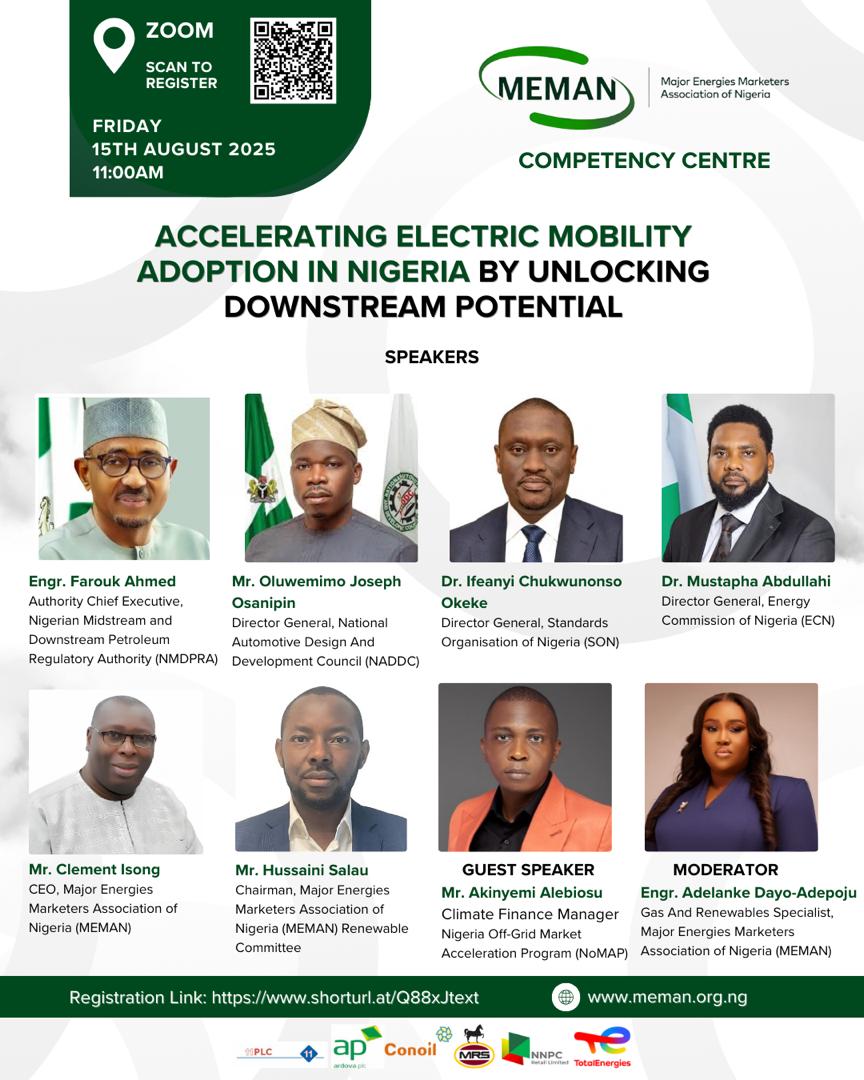
Kingsley Ojimba – Jetty Superintendent, MEMAN
Welcome Message:
Clement Isong – CEO/ES, MEMAN
Opening Remarks:
- Dr. Mukaila Oseni – Director, Operations (Distribution Systems, Storage and Retailing Infrastructure DSSRI), representing Engr. Farouk Ahmed, ACE, NMDPRA
- Engr. Mohammed Adam Mundu – Director of Energy Utilisation Management, transport as an end-use sector, representing Dr. Mustapha Abdullahi, DG, ECN
Keynote Address:
- Engr. Abdullahi Ayinde – Director, Vehicle Electrification Department representing Mr. Oluwemimo Joseph Osanipin, NADDCC
- Engr John Bature Francis – Group Head, Electrical/Electronics, representing Dr Ifeanyi Okeke, DG, SON
Panel Discussion:
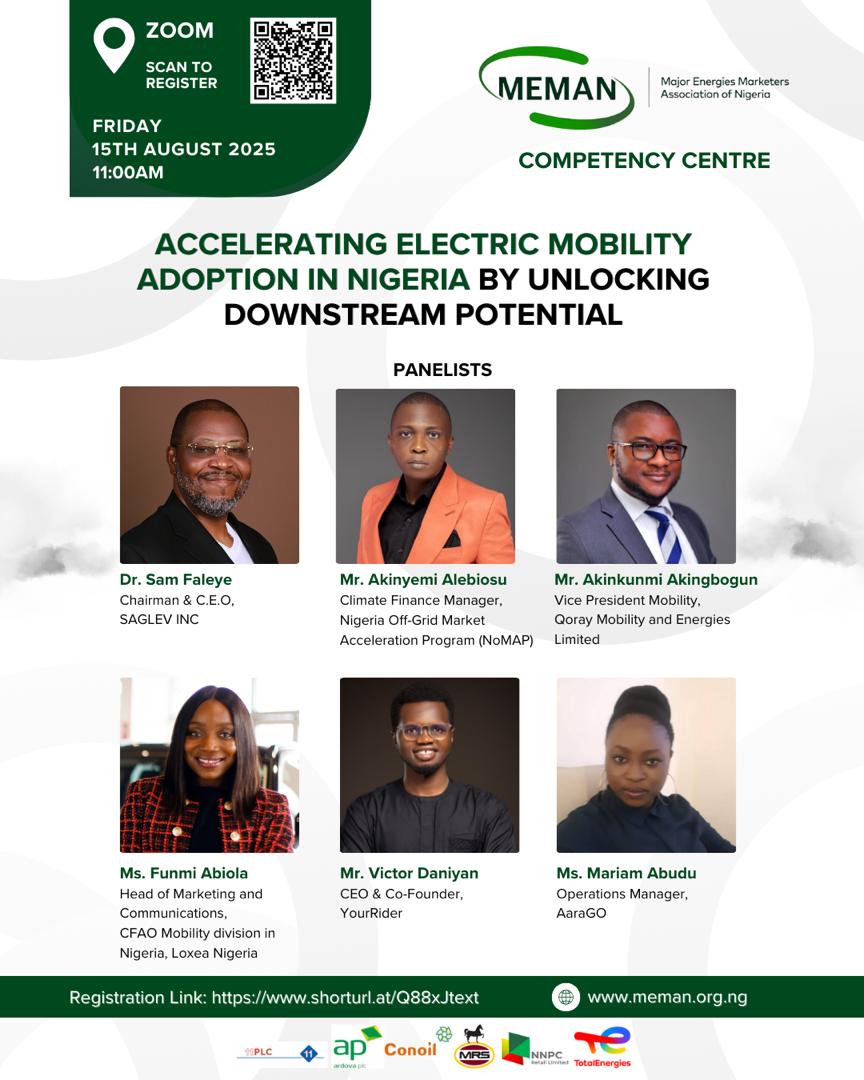
- Dr. Sam Faleye – CEO, Saglev INC
- Mr Akinkunmi Akingbogun – Vice President Mobility, Qoray Mobility and Energies Limited
- Ms. Funmi Abiola – Head of Marketing and Communications, CFAO Mobility Division, Loxea Nigeria
- Ms. Daisy Emah-Emah – Growth and Strategy, representing Mr Victor Daniyan, CEO & Co-Founder, YourRider
- Ms Mariam Abudu – Operations Manager, AaraGO
- Akinyemi Alebiosu – Climate Finance Manager, Nigeria Off-Grid Market Accelerator Program (NoMAP)
Closing Remarks:
Engr Hussaini Salau – Chairman, MEMAN Renewable Committee
Moderator:
Adelanke Dayo-Adepoju – Gas and Renewables Specialist, MEMAN
The Major Energies Marketers Association of Nigeria (MEMAN), through its Competency Centre, convened a webinar on accelerating electric mobility adoption in Nigeria. The session brought together regulators, automotive leaders, financiers, innovators, and the press to examine Nigeria’s readiness for electric vehicles (EVs) and the opportunities, challenges, and regulatory frameworks shaping the transition.
With transportation contributing nearly 28% of Nigeria’s greenhouse gas emissions and rising fuel costs burdening consumers, the webinar underscored the urgency of sustainable mobility solutions. Participants explored EV adoption as part of Nigeria’s broader energy transition, while also highlighting interim alternatives such as Compressed Natural Gas (CNG) and Liquefied Petroleum Gas (LPG). Discussions covered infrastructure readiness, financing, local auto assembly, standards, innovation, and the role of consumer awareness in building a sustainable EV ecosystem.
Key Discussion Points
- Safety Briefing and Welcome Address
The webinar opened with a safety briefing delivered by Kingsley Ojimba, MEMAN Jetty Superintendent. He reminded participants about cyber hygiene and attentiveness during virtual engagements. This was followed by a welcome address from Mr. Clement Isong, MEMAN’s CEO and Executive Secretary. He highlighted MEMAN’s role in Nigeria’s energy transition and innovation agenda, citing progress with 12 EV charging, battery swapping sites and 5 after-sales facilities nationwide. He emphasised new opportunities such as solar-powered charging, battery-swapping networks, and the scaling of two- and three-wheelers as entry points for adoption. Mr. Isong called for collaboration between regulators, investors, and private sector players, stressing MEMAN’s commitment to creating a supportive platform for dialogue and knowledge sharing. - Nigeria’s Readiness for EV Adoption
Dr. Mukaila Oseni (Director of Operations, DSSRI at NMDPRA) situated Nigeria’s EV journey within a global context, citing the International Energy Agency’s forecast of 145 million EVs worldwide by 2030. He identified EVs as critical to diversifying Nigeria’s energy mix, reducing long-term transport costs, and cutting emissions. However, he noted significant barriers including high vehicle costs, limited charging infrastructure, unreliable grid electricity, and low public awareness.
Dr. Oseni revealed that NMDPRA is updating its regulatory framework to encourage infrastructure development, technological innovation, and investor incentives. He advocated for leveraging Nigeria’s expansive downstream network of fuel retail stations as ready-made sites for EV charging, supported by mini grids to ensure reliability. Tying EVs to Nigeria’s “Decade of Gas” strategy, he underscored how CNG and LPG can provide transitional solutions while EV adoption scales.
- Government Commitment and the Auto Sector’s Role
Engr. Mohammed Adam Mundu (Director of Energy Utilisation, ECN) reinforced the government’s commitment to decarbonization and highlighted filling stations as ideal sites for EV charging given their existing excess power capacity. He emphasised the importance of integrating solar energy to ensure sustainability and affordability.
Engr. Abdullahi Ayinde (Director, Vehicle Electrification Department, NADDC) added a strong warning: Nigeria’s EV strategy must be demand-driven. He stressed that without clear market demand, businesses risk collapse, as seen with past auto assembly failures. He pointed to the decline in local content, from 40% in the 1980s to under 10% today, as a sign that policies must prioritise sustainable demand creation. He recommended focusing on sectors with immediate needs, such as agriculture, haulage, and mass transit, while promoting CKD (completely knocked down) assembly to stimulate jobs and technology transfer.
- Standardisation as a Foundation for Growth
Representing the SON, Engr. John Bature Francis (Group Head, Electrical/Electronics) highlighted the urgent need for standards to ensure consumer safety, investor confidence, and market stability. He observed that unregulated EV models are already spreading in states like Borno, with multiple incompatible technologies risking fragmentation.
SON has already identified over 40 international standards on EV batteries, charging connectors, and payment systems, and is working on a national committee to adapt them to Nigeria’s context. Aligning with the Nigerian Automotive Industry Development Plan, which targets 30% local EV production, Engr. Bature noted that standards are the backbone for scaling adoption. He invited collaboration with industry stakeholders and international bodies like IEC and ISO, affirming SON’s role in providing the framework for a mature, safe, and globally competitive EV market in Nigeria.
- Sizing the Opportunity: EV Market Trends, Consumer Insights, and Demand Drivers in Nigeria
Mr. Akinyemi Alebiosu (Climate Finance Manager, NOMAP) underscored that the EV revolution is inevitable, drawing parallels with technologies once considered futuristic but now commonplace. He highlighted Nigeria’s overdependence on imported used vehicles, high transport costs, currency depreciation, and fuel price volatility as drivers of EV urgency. He noted that transitioning Nigeria’s transport sector, which accounts for 28% of emissions, is essential for achieving the 2060 net-zero target.
Market projections suggest that West Africa will host nearly 9.9 million EVs by 2050, with Nigeria accounting for the largest share. This will require an estimated $20 billion in infrastructure investment. Within Nigeria, the market outlook spans across 2 & 3 wheelers (8–10 million units), 4-wheel vehicles (5–7 million units), buses (40–70 thousand), and trucks (40–75 thousand). Financing models are expected to vary, ranging from upfront purchase, leasing, and hire-purchase for smaller vehicles, to public–private partnerships for buses, and strategic partnerships, such as Sinotruck and BHN, for trucks. The range of electric vehicle types anticipated includes e-bicycles, e-motorcycles, and e-Keke; electric cars and light commercial vehicles; articulated buses; and e-trucks.
Mr. Alebiosu advocated blended finance models to mobilize private sector capital and cited successful pilots such as Lagos e-buses and a Nigerian bank replacing its entire fleet with EVs. Opportunities were identified in battery manufacturing, battery swapping, charging infrastructure, and mini grid, warning that Nigeria must be an active participant rather than a passive consumer in the EV future.
- Building a Viable E-Mobility Ecosystem: Collaboration Across Energy, Transport, and Technology Sectors
The panel session showcased practical solutions from private players:
- Dr. Sam Falaye, CEO, SAGLEV Inc.: Highlighted their production of 16 EV models, including BRT buses, and outlined charging business models (pay-per-use, subscriptions, sponsorships). He stressed the role of solar integration but warned that storage costs remain a major challenge.
- Mr. Akinkunmi Akingbogun, Vice President Mobility, Qoray Mobility & Energies Limited: Shared their success in selling over 50 EVs, assembling tricycles, launching Cab Zero ride-hailing, and training 100+ technicians. He emphasised a battery-as-a-service model that separates vehicle and battery ownership, reducing upfront costs while creating revenue streams for banks and vendors.
- Ms. Funmi Abiola, Head of Marketing and Communications, CFAO Mobility Division, Loxea Nigeria: Discussed BYD’s entry into Nigeria, home-charging solutions, and reliable aftersales services backed by CFAO’s 120+ years in Nigeria. She noted that EV adoption hinges not only on affordability but also on reducing the total cost of ownership.
- Ms. Mariam Abudu, Operations Manager, AaraGO: Presented their solar-powered battery-swap model for two-wheelers, where depleted batteries can be exchanged in under a minute. She detailed lifecycle management, including repurposing old batteries into mini grids before recycling.
- Ms. Daisy Emah-Emah, Growth & Strategy Lead, YourRider: Focused on last-mile delivery and ride-hailing operators, highlighting the integration of battery swap stations and rider training to improve safety and market confidence.
- Collaboration, Media Transparency, and Responsible Adoption
Speakers agreed that Nigeria’s EV adoption must be anchored on collaboration between regulators, the private sector, financiers, and consumers. Standards, financing, and infrastructure were identified as critical enablers.
The media was highlighted as a vital partner in shaping public awareness and ensuring accountability. Journalists were encouraged to actively report on market developments, standards adoption, financing innovations, and consumer experiences to ensure public trust.
Conclusion
The session concluded with remarks from Engr. Hussaini Salau, Chairman of MEMAN’s Renewable Committee, commended participants and reiterated that Nigeria’s downstream sector will play a central role in accelerating e-mobility. He emphasised the strategic importance of two- and three-wheelers as entry points for scale adoption and urged stakeholders to “accelerate responsibly” by integrating EV infrastructure into service stations nationwide.
The webinar ended with a collective commitment to build a sustainable, standards-driven, and inclusive EV ecosystem for Nigeria, anchored on innovation, collaboration, and strong regulatory frameworks to ensure affordability, safety, and consumer protection.