

Purpose
To educate the Nigerian public on safe gas cylinder usage, requalification requirements, how to identify certified cylinders, emerging risks in the market, and the roles of regulators and industry players in protecting the consumers.
Presentations
Safety Briefing:
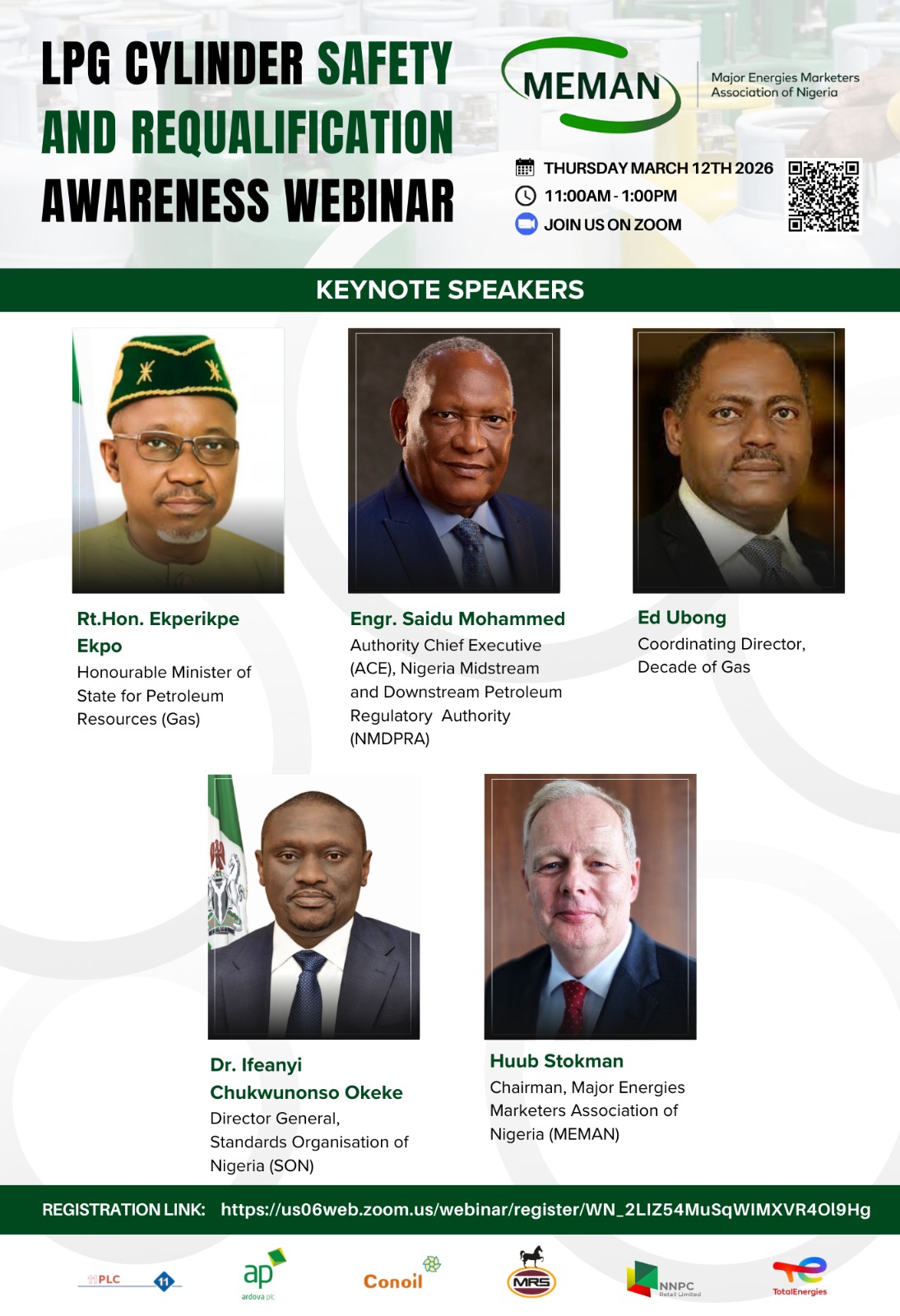
Engr. Moses Okoh – Operations Manager, MEMAN
Welcome Message:
Huub Stokman – Chairman, MEMAN & MD, NNPC Retail Limited
Keynote Address:
Ekperikpe Ekpo – Honourable Minister of State for Petroleum Resources (Gas) (represented by Mr. Abel Igheghe, Technical Adviser)
Opening Remarks:
- Saidu Mohammed – Authority Chief Executive, Nigeria Midstream and Downstream Petroleum Regulatory Authority (NMDPRA) (represented by Engr. Oliver Amos, Director, Process Safety & Health)
- Akachukwu Nwokedi – President, Nigerian Gas Association
- Ifeanyi Chukwunonso Okeke – Director General, Standards Organisation of Nigeria (represented by Manji Pious, SA-Strategic Support)
- Ed Ubong – Coordinating Director, Decade of Gas Secretariat (represented by Natasha Ugochukwu, Supply Workstream Lead)
Welcome Address:
- Isioma Martins – Chairperson, Online Programs, Women in LPG Nigeria
- Femi Fanoiki – 1st Vice President, Nigerian Liquefied and Compressed Gas Association (NLCGA)
- Edu Inyang – National President, Nigerian Association of LPG Marketers (NALPGAM)
- Ayobami Olarinoye – National Chairman, LPGAR (NUPENG Branch)
Presentations:
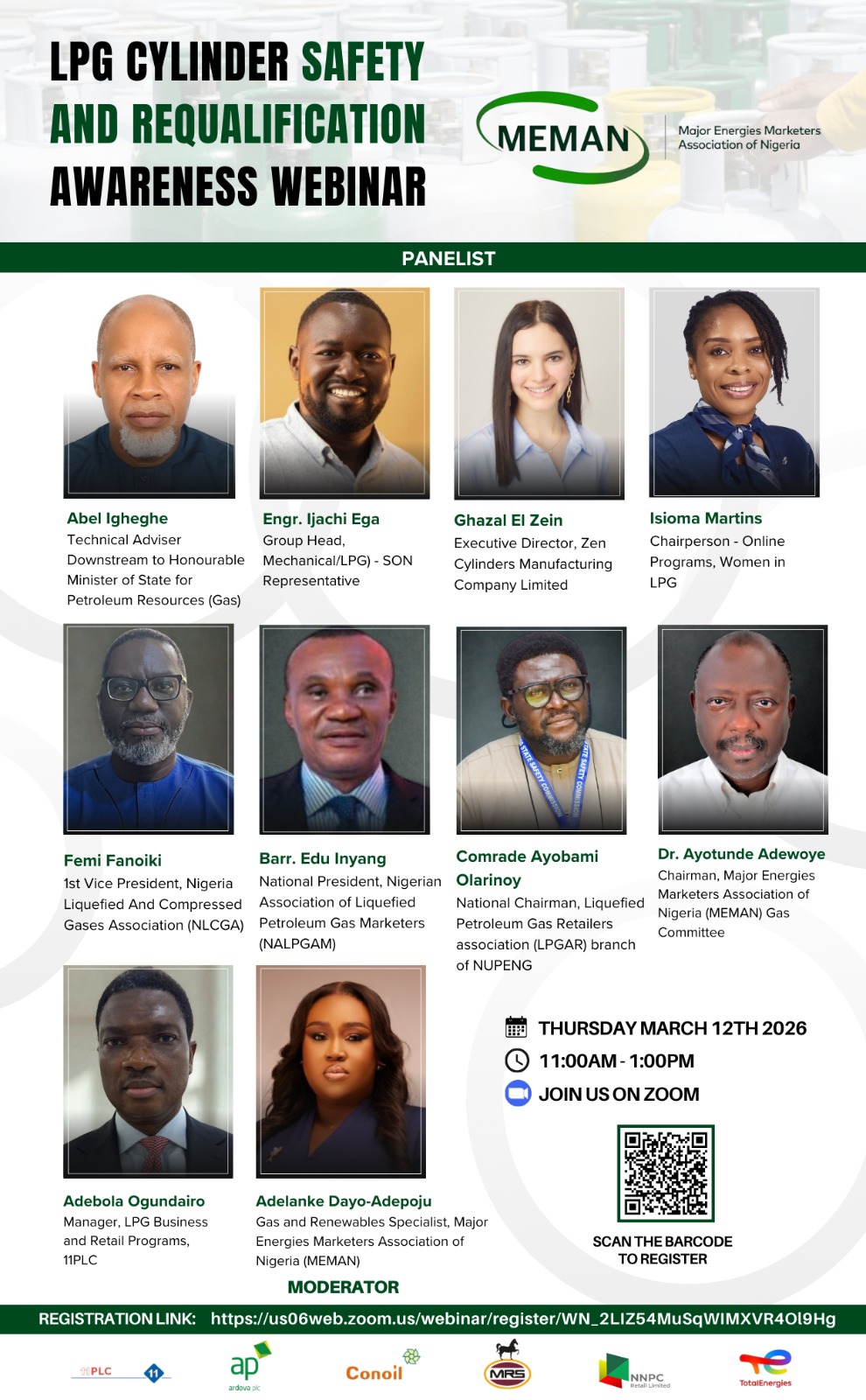
- Engr. Ijachi Ega, Group Head, Mechanical/LPG, Standards Organisation of Nigeria
- Ghazal El Zein – Executive Director, Zen Cylinders Manufacturing Company Limited
Panel Discussion:
- Ekperikpe Ekpo – Honourable Minister of State for Petroleum Resources (Gas) (represented by Mr. Abel Igheghe, Technical Adviser)
- Engr. Ijachi Ega, Group Head, Mechanical/LPG, Standards Organisation of Nigeria
- Saidu Mohammed – Authority Chief Executive, Nigeria Midstream and Downstream Petroleum Regulatory Authority (NMDPRA) (represented by Engr. Oliver Amos, Director, Process Safety & Health)
- Ghazal El Zein – Executive Director, Zen Cylinders Manufacturing Company Limited
- Adebola Ogundairo – Manager, LPG Business and Retail Programs, 11PLC
- Isioma Martins – Chairperson, Online Programs, Women in LPG Nigeria
- Taji Ogbe – Executive Secretary, Nigerian Gas Association
- Femi Fanoiki – 1st Vice President, Nigerian Liquefied and Compressed Gas Association (NLCGA)
- Edu Inyang – National President, Nigerian Association of LPG Marketers (NALPGAM)
- Ayobami Olarinoye – National Chairman, LPGAR (NUPENG Branch)
Closing Remarks:
Dr. Ayotunde Adewoye – Chairman, MEMAN Gas Committee
Moderator:
Adelanke Dayo-Adepoju – Gas and Renewables Specialist, MEMAN
The Major Energies Marketers Association of Nigeria (MEMAN) convened a virtual public-awareness webinar on LPG Cylinder Safety and Requalification to educate industry stakeholders and consumers on safe LPG cylinder usage, requalification requirements, and how to identify certified cylinders in the Nigerian market.
The session brought together representatives from government, regulators, industry associations, manufacturers, and marketers to address safety risks within Nigeria’s LPG ecosystem and explore solutions for strengthening regulatory enforcement, market surveillance, and consumer awareness.
Discussions focused on the rapid growth of LPG adoption under Nigeria’s Decade of Gas agenda, the need for improved safety compliance across the LPG value chain, the importance of periodic cylinder requalification, and the challenges created by substandard cylinders, informal retail practices, and weak traceability systems.
The webinar combined opening remarks and policy perspectives with technical presentations on identifying certified cylinders and the cylinder requalification process, followed by an interactive panel discussion examining enforcement, market practices, and structural challenges affecting cylinder safety in Nigeria.
Key Discussion Points
- Safety Briefing & Opening Remarks
The webinar opened with a safety briefing delivered by Engineer Moses Okoh, Operations Manager at MEMAN, emphasizing the importance of personal safety awareness in all environments. Participants were encouraged to remain alert to hazards around them, identify emergency exit routes, avoid distractions such as driving during the session, and ensure their immediate surroundings remained safe.
In his welcome address, MEMAN Chairman, Huub Stokman highlighted the importance of LPG within Nigeria’s Decade of Gas initiative as a key pathway toward expanding clean cooking energy. He noted that as LPG adoption grows, stronger attention must be paid to safety standards, consumer awareness, and compliance across the value chain. Because cylinders represent the most visible component of the LPG system, proper certification, safe handling, and periodic requalification are essential to protecting consumers.
- Strategic Importance of LPG in Nigeria’s Energy Transition
The keynote address delivered by Mr. Abel Igheghe on behalf of the Honourable Minister of State for Petroleum Resources (Gas) highlighted the growing importance of LPG within Nigeria’s broader energy transition strategy.
Nigeria’s abundant natural gas resources are being leveraged under the Decade of Gas initiative to reduce energy poverty, support economic development, and promote environmentally sustainable energy solutions. LPG plays a particularly important role in advancing clean cooking, reducing reliance on biomass and firewood, improving indoor air quality, and slowing deforestation.
Nigeria’s LPG consumption has grown significantly, rising from less than 100,000 metric tonnes in the early 2000s to approximately 1.4 million metric tonnes today. Government initiatives supporting this growth include nationwide cylinder distribution programs, awareness campaigns across the country’s 774 local government areas, and programs aimed at expanding access to clean cooking energy.
- Opening Remarks
NMDPRA
Engr. Oliver Amos representing the Nigerian Midstream and Downstream Petroleum Regulatory Authority (NMDPRA) delivered opening remarks on behalf of the Authority Chief Executive. The regulator commended MEMAN for convening the awareness initiative and stressed that cylinder safety is a critical regulatory priority. The remarks highlighted the need to strengthen regulatory enforcement and market surveillance, hold industry actors accountable, and foster stakeholder collaboration across the LPG value chain.
He also acknowledged the important role played by the Standards Organisation of Nigeria in ensuring that cylinder qualification and requalification standards are applied consistently.
Nigerian Gas Association
The President of the Nigerian Gas Association (NGA), Mr. Akachukwu Nwokedi delivered remarks, commending MEMAN for convening the session. He described LPG as central to clean cooking, household energy access, and environmental sustainability, framing cylinder safety as a major public safety concern rather than merely a technical issue. He noted that millions of Nigerians rely on LPG for cooking, making it essential that cylinders used in homes, restaurants, and businesses are certified, properly maintained, and periodically requalified.
The remarks outlined three priority actions to improve safety: strengthening consumer awareness so individuals can identify safe and certified cylinders; enhancing enforcement and market surveillance to remove substandard or expired cylinders from circulation; and promoting industry collaboration and self-regulation to maintain consistently high safety standards. He encouraged participants to actively engage and apply lessons learned across their organisations and communities.
Standards Organisation of Nigeria (SON)
Manji Pious delivered remarks on behalf of the Director General of the SON, commending MEMAN for organising the webinar. The agency explained its regulatory role in developing national standards, adopting international standards where local benchmarks do not exist, certifying products, inspecting imports, and enforcing compliance to penalise violators.
SON outlined steps taken to strengthen LPG sector safety, including developing and adopting relevant standards, continuous training of engineers, and establishing cylinder requalification centres that verify and recertify cylinders every five years.
He emphasised that requalification is non-negotiable because the failure of pressurised gas vessels can have catastrophic consequences, and highlighted ongoing collaboration with the Presidency and National Assembly to remove substandard cylinders from circulation.
Decade of Gas Secretariat
Natasha Ugochukwu delivered remarks on behalf of the Coordinating Director, noting the timeliness of the webinar and stressing that safety is vital for consumer protection, market confidence, and long-term LPG sector sustainability.
The Secretariat presented plans for the National LPG Penetration Program, targeting five million Nigerian households by 2030, and emphasised that as LPG adoption expands, safety must be strengthened across the entire cylinder lifecycle, including manufacturing, distribution, usage, maintenance, and periodic requalification.
The Secretariat reaffirmed its commitment to working with regulators, industry associations, and operators to ensure the expansion of LPG access delivers economic, social, and environmental benefits.
Women in LPG Nigeria
Mrs. Isioma Martins representing the Women in LPG Nigeria (WinLPG) shared perspectives shaped by members who are both industry operators and household LPG users. She highlighted that women frequently encounter uncertainty about whether cylinders in their homes are certified, expired, or structurally compromised, revealing safety gaps between regulatory standards and market practices.
WinLPG thanked MEMAN for convening stakeholders to address these challenges and urged targeted outreach that speaks directly to household users, especially women, who are primary cooks in many homes.
Nigerian Liquefied and Compressed Gas Association (NLCGA)
The First Vice President of the Nigerian Liquefied and Compressed Gas Association (NLCGA), Mr. Femi Fanoiki, emphasised the importance of cylinder safety for the continued growth of the LPG market. He noted that LPG penetration in Nigeria is currently estimated at 30–35 percent and stated that the expansion of LPG usage depends on the availability of safe cylinders.
He also stressed that cylinders are the primary interface between the industry and consumers, making public trust in cylinder safety critical. The speaker reaffirmed the association’s commitment to promoting safety awareness and supporting collaborative initiatives to strengthen sector standards.
NALPGAM
The National President of the Nigerian Association of LPG Marketers (NALPGAM), Barr. Edu Inyang highlighted the critical role marketers play as direct points of contact with retailers and end users. He stressed that LPG cylinders are pressurised vessels that can cause severe harm if safety is compromised. The president encouraged marketers to routinely inspect cylinders and valves before filling, identify leaks or faults, and ensure that only safe cylinders are used. The association welcomed the webinar as an opportunity to deepen safety knowledge and improve industry practices.
LPG Retailers Association (NUPENG Branch)
The National Chairman representing LPG retailers under NUPENG, Comrade Ayobami Olarinoye, emphasised that retailers are the final link between the industry and end users, making their role in safety crucial. He observed that LPG consumption in Nigeria is growing rapidly and argued that safety discussions must extend beyond cylinders to include regulators, hoses, clips, and fittings, all of which significantly impact overall safety during usage.
- Identifying Certified LPG Cylinders
A technical presentation from SON delivered by Engr. Ijachi Ega, Group Head, Mechanical/LPG, provided practical guidance on how consumers and operators can identify certified LPG cylinders.
Key indicators of certified cylinders include visible manufacturer identification, product registration numbers, unique serial numbers, country of origin markings, design pressure information, and stamped manufacturing dates. Consumers were advised to calculate cylinder expiry by adding approximately fifteen years to the date of manufacture.
Participants were cautioned against purchasing cylinders with poor weld quality, missing manufacturer identification, altered markings, or other structural irregularities. The presentation also warned about the presence of imported used cylinders and illegal refilling operations that may compromise safety.
- LPG Cylinder Requalification Process
Mrs. Ghazai El Zein, Executive Director, Zen Cylinders Manufacturing Company Limited, provided a detailed explanation of the cylinder requalification process and why it is essential to long-term safety.
Requalification typically occurs every five years and involves a multi-stage process that includes collection and identification, external visual inspection, valve removal and internal inspection, hydrostatic pressure testing, corrosion removal and repainting, and final certification with new valves installed.
The process verifies structural integrity, identifies internal corrosion or metal fatigue caused by repeated pressure cycles, and removes contaminants such as water deposits that may accumulate over time. Cylinders that fail inspection are withdrawn from circulation to prevent potential safety incidents.
- Panel Discussion: Enforcement, Market Surveillance and Industry Self-Regulation
The panel discussion examined gaps between regulatory standards and market realities within Nigeria’s LPG sector.
Speakers noted that unsafe practices such as refilling substandard cylinders, repainting expired cylinders, and illegal decanting operations remain widespread in informal markets. Limited enforcement capacity and consumer awareness contribute to the persistence of these practices.
A structural issue highlighted was Nigeria’s individual cylinder ownership model, in which consumers own cylinders while marketers simply refill them. This model creates challenges for traceability, accountability, and enforcement because marketers do not control the condition or lifecycle management of cylinders.
Several participants suggested that a marketer-owned cylinder exchange model, where companies retain ownership of cylinders and consumers exchange empty cylinders for filled ones, could improve traceability and safety compliance.
- Market Risks and Safety Challenges
Participants identified several key risks affecting cylinder safety in Nigeria’s LPG market:
- Circulation of expired or substandard cylinders
- Illegal refill outlets and informal gas retail operations
- Weak traceability and limited inspection capacity
- Consumer lack of awareness about cylinder lifespan and inspection requirements
Experts emphasized that cylinders are pressurized vessels and failures can have severe consequences, making proactive safety management essential.
Industry representatives stressed the need for stronger public education campaigns to ensure consumers understand how to identify certified cylinders and recognize warning signs of potential safety issues.
- Market Growth and Future Safety Requirements
Nigeria’s LPG sector is expected to continue expanding rapidly as clean cooking adoption increases. With national consumption currently estimated at around 1.4 million tonnes annually and future targets reaching approximately 5 million tonnes, experts estimate that as many as 90 million cylinders may eventually be required to support market demand.
Managing this growth safely will require improved cylinder lifecycle management, expanded requalification capacity, clearer ownership structures, and stronger collaboration between regulators, manufacturers, marketers, and industry associations.
Conclusion & Closing Remarks
The session concluded with remarks from Dr. Ayotunde Adewoye, Chairman of the MEMAN Gas Committee, who emphasized that sustainable LPG market growth must be supported by strong safety standards, industry investment in quality cylinders, and continuous consumer education.
Speakers reiterated that improving public awareness represents one of the most immediate and effective steps toward enhancing safety across the LPG ecosystem. They also highlighted the importance of closer collaboration between government, regulators, manufacturers, and industry operators to strengthen enforcement, improve cylinder traceability, and remove substandard products from the market.
The webinar ended with participants encouraged to continue supporting initiatives aimed at improving LPG safety awareness and compliance across Nigeria’s growing gas sector.