

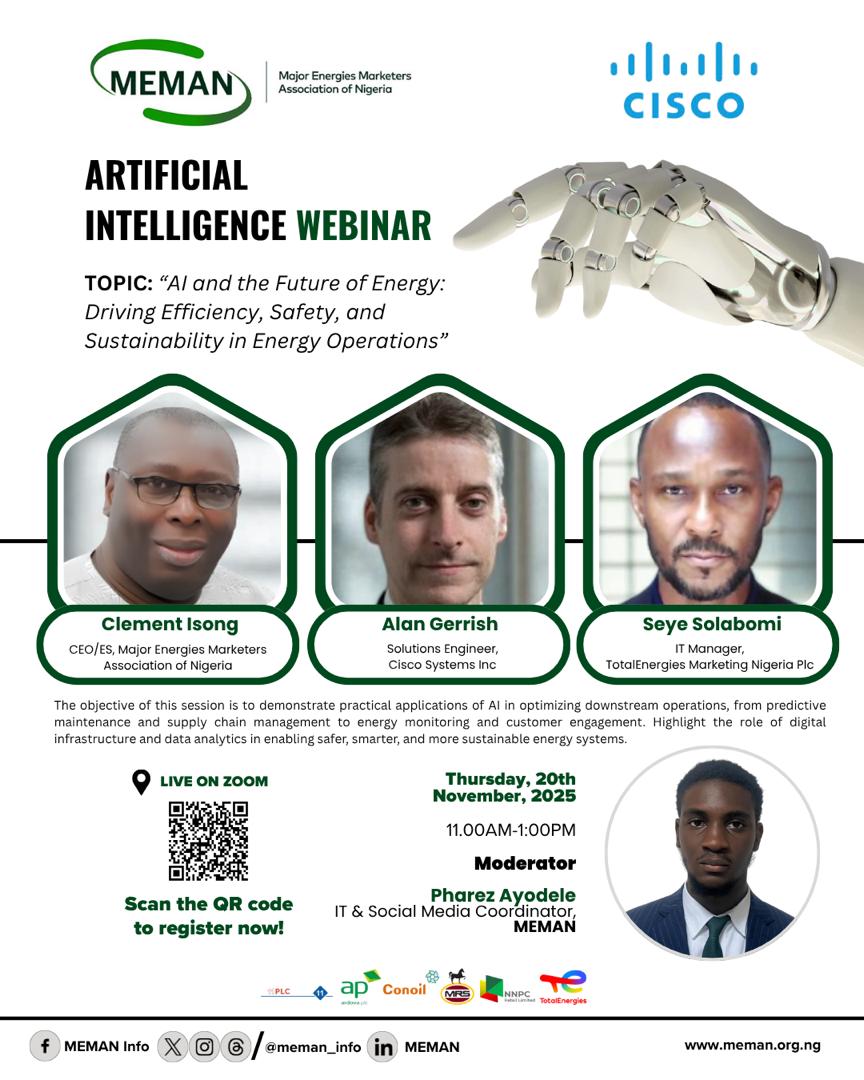
Purpose
To demonstrate practical applications of AI in optimizing downstream operations, from predictive maintenance and supply chain management to energy monitoring and customer engagement.
Presentations
Safety Briefing:
Engr. Moses Okoh – Operations Manager, MEMAN
Opening Remarks:
Olushola Oni – representing Mr Clement Isong, CEO/ES, MEMAN
Speakers:
-
Alan Gerrish – Technical Solutions Architect / Solutions Engineer, Cisco Systems Inc.
-
Seye Solabomi – IT Manager & Solutions Architect, TotalEnergies Marketing Nigeria PLC
Moderator:
Pharez Ayodele – IT & Social Media Coordinator, MEMAN
Overview
MEMAN convened a focused, two-hour webinar that explored how artificial intelligence particularly generative AI, vision models, and agentic architectures is being applied to improve downstream energy operations. The session combined technical presentations from Cisco and TotalEnergies Marketing Nigeria PLC, practical customer examples, and a live audience Q&A addressing deployment choices, governance, workforce impacts and regulatory considerations.
The webinar positioned AI as an enabler rather than an end in itself: when projects begin with clearly defined business outcomes, they deliver measurable improvements in maintenance, security, operational efficiency and customer engagement while requiring careful attention to sizing, observability, security and human oversight.
Session flow
The event began with a short safety briefing emphasising situational awareness and participant protocols, followed by opening remarks from Mr. Olushola Oni and a prerecorded AI-generated message from MEMAN’s CEO, Mr. Clement Isong. In his opening remarks Mr. Oni described the webinar as a strategic collaboration with Cisco to explore how AI can drive efficiency, safety and sustainability across downstream energy operations. He highlighted MEMAN’s role in convening stakeholders, fostering collaboration, and supporting practical pilot projects and policy engagement. Cisco’s presentation examined generative AI deployment patterns, operational constraints and a concrete multimodal customer use case for CCTV automation. TotalEnergies Marketing Nigeria PLC followed with a practical, operations focused talk that linked AI use cases from predictive maintenance to smart grid optimisation with governance, workforce and sustainability considerations. The webinar closed with an extended Q&A addressing technical, regulatory and workforce questions from the audience.
Key discussion points
- Practical deployment patterns for generative AI (Cisco)
Alan Gerrish reviewed the recent momentum behind generative AI and emphasised that organisations are increasingly moving from experimentation to production. He described the common architecture decisions organisations face: whether to run inference on‑premises, at the edge, in co‑located facilities or in public cloud, and why those choices are driven by latency, data sovereignty, cost and operational considerations.
Gerrish stressed a use‑case‑first approach: projects that define measurable success criteria before procuring infrastructure have a higher chance of delivering ROI. He outlined typical cross‑industry applications production optimisation, asset monitoring and predictive maintenance, vision inspection and autonomous control, supply‑chain optimisation and document/compliance automation and shared a concrete oil & gas deployment where a multimodal vision model, a small language model and agent orchestration automated CCTV review and incident detection. The result was faster incident analysis, fewer manual reviews and demonstrable safety and loss‑prevention benefits.
- Operational engineering: sizing, observability and security
A recurring theme was the importance of systems engineering. Gerrish explained that model size, concurrency and input length determine compute, networking and storage requirements; that GPU clusters must be networked and observed as cohesive systems; and that observability (metrics such as tokens per second and time‑to‑first‑token) is essential to convert technical performance into cost and capacity planning. Security considerations go beyond firewalls to include container protections, model‑level defences and audit tools that track model usage and detect abuse or jailbreak attempts.
Cisco’s offerings, a whole‑stack approach combining frameworks, accelerated compute, networking, storage, and operator tooling were presented as a way to reduce integration friction and accelerate production rollout while providing integrated security and telemetry.
- Customer journey and governance
The customer journey outlined ideation, use‑case definition, proof of value/proof of concept, sizing and fit‑for‑purpose design before deployment emphasises iterative validation and avoiding shadow‑IT. The presenters showed examples of governance workflows used internally and by customers (an internal routing platform to ensure safe model selection and to reduce risky use of public models).
- Practical downstream examples and quantified benefits (TotalEnergies)
Mr. Solabomi reinforced that AI’s value lies in application. He described successful use cases including predictive maintenance, autonomous optical gas imaging (OGI) drone inspections, renewables integration, smart‑grid optimisation, and customer segmentation. A representative example highlighted how predictive maintenance on a 50 MW solar plant produced roughly a 30% reduction in unplanned downtime, delivering a six‑figure annual benefit.
Solabomi also noted the environmental trade‑offs: AI systems consume energy, so benefits must be evaluated alongside their carbon and energy cost. He emphasised cross‑functional change management, reskilling and human‑in‑the‑loop safeguards as prerequisites for safe, sustainable adoption.
- Workforce and governance implications
Participants raised concerns about job displacement and auditability. Presenters acknowledged that while automation removes certain manual tasks, it also creates roles operators, supervisors, domain specialists, and AI auditors and that deliberate reskilling pathways are required. Governance recommendations included multi‑disciplinary oversight (technical, legal and operational), continuous audit practices, manual override (kill‑switch) design, and active engagement with regulators and standards bodies.
Q&A highlights
- Private vs public AI platforms: The panel recommended private/internal deployments where data sensitivity, sovereignty or regulatory risk are concerns. Internal platforms reduce the risk of uncontrolled data exposure and allow enterprises to retain governance over fine‑tuning and model behaviour.
- Data usage & model improvement: Organisations running internal platforms typically collect operational telemetry, annotated outputs and use‑case data to refine models for their environment. Strict data governance and access controls are required to manage privacy and compliance.
- Jobs & reskilling: While automation removes some manual tasks, it creates roles (drone operators and supervisors, AI auditors, model operators, domain data stewards). Active reskilling pathways and role redesign are essential to capture these new opportunities.
- Auditability & governance: Continuous audits, model‑level defences, manual override (kill‑switch) design and multi‑disciplinary governance (technical, legal, safety, compliance) were emphasised as necessary to detect bias, bugs or malicious behaviour.
- Regulatory approach for Africa: Panellists favoured evolutionary updates to existing energy and data frameworks (a “handshake” between regulators) rather than standalone, burdensome regimes; industry engagement in standards development was encouraged to avoid fragmentation.
Key Takeaways
- Begin with use cases and measurable outcomes. Define success metrics and ROI up front; avoid buying infrastructure before you know what you need.
- Plan for where inference will run. On‑prem and edge inferencing are often required for latency, sovereignty and security considerations size networking, storage and orchestration accordingly.
- Embed security and observability across the stack. Go beyond perimeter controls: implement container protections, model‑level defences, telemetry (tokens/sec, time‑to‑first‑token) and continuous monitoring to convert technical metrics into cost and performance insights.
- Preserve human oversight. Design manual overrides, monitoring and human‑in‑the‑loop checkpoints; governance and fail‑safes reduce operational risk.
- Invest in people. Reskilling, cross‑functional collaboration and role redesign (not just technical hires) enable sustainable adoption and job creation.
- Regulation should be collaborative and incremental. Work with standards bodies and regulators to integrate AI clauses into existing regimes and avoid unnecessary compliance burdens.
Conclusion
The webinar demonstrated that AI delivers tangible operational value in downstream energy when projects are defined by business outcomes, sized correctly, governed effectively and deployed with human oversight. Both Cisco and TotalEnergies emphasised practical steps ideation workshops, PoC/PoV phases, sizing, secure deployment and observability as repeatable building blocks for scaling AI responsibly across the sector. MEMAN closed the session by encouraging follow‑up engagement through the Competency Centre and workshops to translate ideas into pilot projects and governance frameworks.